interactive musuem display
interactive musuem display
Creating 'awe' with interactive museum companion to deepend visitor engagement
Creating 'awe' with interactive museum companion to deepend visitor engagement
Client
Client
Durham Life and Science Museum
Durham Life and Science Museum
Year
Year
Fall 2025 (4 Weeks)
Fall 2025 (4 Weeks)
Role
Role
UI and UX Design
UI and UX Design
Team
Team
1 UX Designer
1 UX Designer
Client
SAS
Year
Spring 2025 (8 weeks)
Role
UI Interface, UX Design, & Scenario Video
Team
3 UX Designers
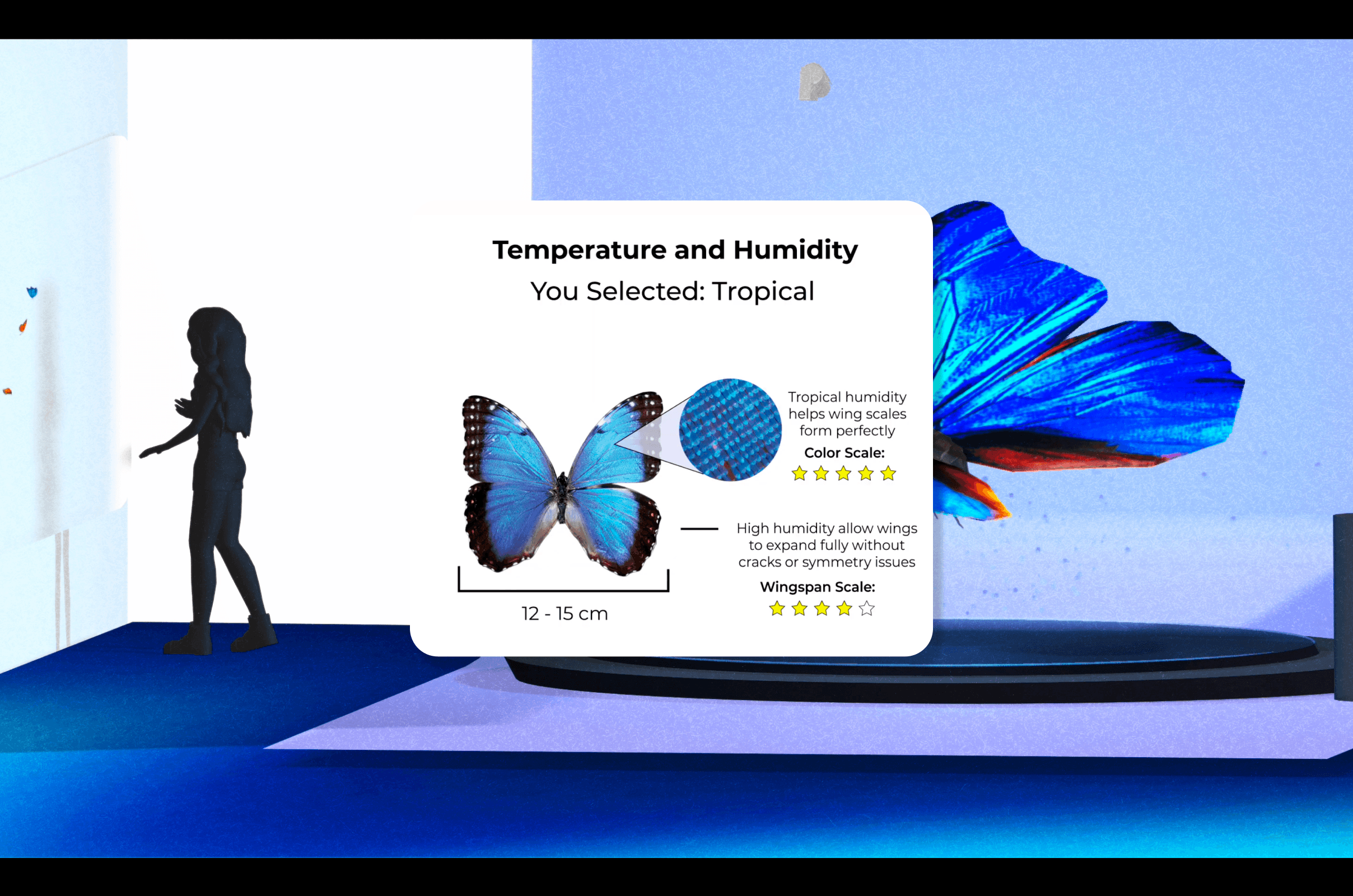
An immersive museum experience that uses interactive technology to help visitors build a personal connection to the metamorphosis journey. Many guests move through exhibits passively, missing the emotional and educational impact behind the science. Our goal was to transform that experience by inviting visitors to co-create their own butterfly, make choices that shape its story, and see those decisions come to life through projection mapping and personalized interactions. By blending education, awe, and narrative-driven design, Butterfly Companion encourages visitors to understand metamorphosis not just as a process, but as a living story they can feel connected to.
An immersive museum experience that uses interactive technology to help visitors build a personal connection to the metamorphosis journey. Many guests move through exhibits passively, missing the emotional and educational impact behind the science. Our goal was to transform that experience by inviting visitors to co-create their own butterfly, make choices that shape its story, and see those decisions come to life through projection mapping and personalized interactions. By blending education, awe, and narrative-driven design, Butterfly Companion encourages visitors to understand metamorphosis not just as a process, but as a living story they can feel connected to.
Background
Background
The Museum of Life + Science is a large, interactive museum known for its science exhibitions and nature-based experiences. Its mission is to ignite curiosity and build a community connected to science through playful learning that enriches individuals and the world around them.
The Museum of Life + Science is a large, interactive museum known for its science exhibitions and nature-based experiences. Its mission is to ignite curiosity and build a community connected to science through playful learning that enriches individuals and the world around them.
Magic Wings Butterfly House
Magic Wings Butterfly House
Home to one of the largest butterfly houses on the East Coast, the Magic Wings Butterfly House features a 35-foot-tall glass conservatory where guests can step into a lush rainforest environment and immerse themselves in hundreds of tropical butterflies.
Home to one of the largest butterfly houses on the East Coast, the Magic Wings Butterfly House features a 35-foot-tall glass conservatory where guests can step into a lush rainforest environment and immerse themselves in hundreds of tropical butterflies.
The task
The task
In partnership with the Museum of Life + Science, our task was to design a technology-enhanced visitor experience hypothetically installed in the Butterfly Conservatory. The goal was to help guests explore, learn, and engage with conservation stories connected to the butterflies.
In partnership with the Museum of Life + Science, our task was to design a technology-enhanced visitor experience hypothetically installed in the Butterfly Conservatory. The goal was to help guests explore, learn, and engage with conservation stories connected to the butterflies.
Design a tech-enhanced experience that brings butterfly conservation to life
Design a tech-enhanced experience that brings butterfly conservation to life
Design a tech-enhanced experience that brings butterfly conservation to life
Research
Research
Exploring innovative technology
Exploring innovative technology
We researched technologies commonly used in museum environments to understand how they could enhance immersion and storytelling.
We researched technologies commonly used in museum environments to understand how they could enhance immersion and storytelling.
Projection Mapping
Interactive projection mapping transforms static surfaces into moving, responsive visuals. In museum spaces, it allows visitors to influence imagery through movement or gesture, creating dynamic and engaging environments.
Projection Mapping
Interactive projection mapping transforms static surfaces into moving, responsive visuals. In museum spaces, it allows visitors to influence imagery through movement or gesture, creating dynamic and engaging environments.
Smart Bracelets
Wearable technology can create personal, trackable interactions throughout an exhibit. By connecting decisions to a visitor’s bracelet, each person can build a unique relationship with their butterfly companion as they move through the experience.
Smart Bracelets
Wearable technology can create personal, trackable interactions throughout an exhibit. By connecting decisions to a visitor’s bracelet, each person can build a unique relationship with their butterfly companion as they move through the experience.
Gamified Experiences
Game design elements, like challenges or choices, can motivate visitors to participate and learn actively. Museums use gamification to turn education into a hands-on, exploratory journey.
Gamified Experiences
Game design elements, like challenges or choices, can motivate visitors to participate and learn actively. Museums use gamification to turn education into a hands-on, exploratory journey.
Understanding how small environmental factors shape a butterfly’s entire life
Understanding how small environmental factors shape a butterfly’s entire life
As we explored the conservation story behind butterflies, we wanted to understand the real scientific factors that influence how they grow, survive, and adapt. Our goal was to learn how environmental variables shape a butterfly’s journey, from caterpillar to chrysalis to adult, and how these insights could guide a more meaningful visitor experience rooted in awe, empathy, and environmental responsibility.
Our research showed that tiny ecological decisions can dramatically change a butterfly’s life. Caterpillars are deeply shaped by what they consume, the climate conditions around them, the amount of light they sense, and the surfaces they use for protection. Each factor impacts their growth, coloration, size, and long-term survival.
As we explored the conservation story behind butterflies, we wanted to understand the real scientific factors that influence how they grow, survive, and adapt. Our goal was to learn how environmental variables shape a butterfly’s journey, from caterpillar to chrysalis to adult, and how these insights could guide a more meaningful visitor experience rooted in awe, empathy, and environmental responsibility.
Our research showed that tiny ecological decisions can dramatically change a butterfly’s life. Caterpillars are deeply shaped by what they consume, the climate conditions around them, the amount of light they sense, and the surfaces they use for protection. Each factor impacts their growth, coloration, size, and long-term survival.
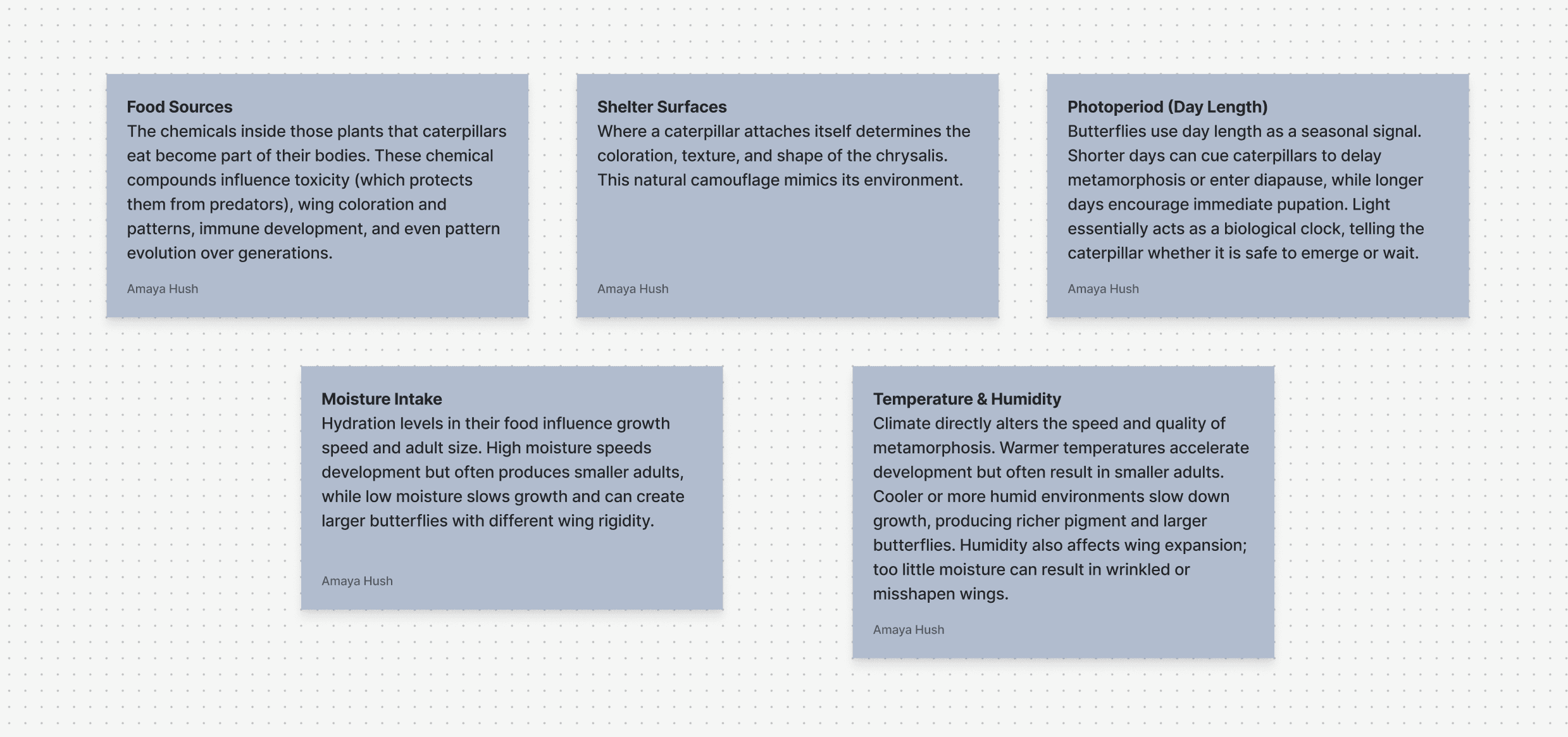
Key insight: Small, everyday environmental factors add up to create extraordinary diversity
Key insight: Small, everyday environmental factors add up to create extraordinary diversity
Market research
Market research
What did other platforms provide?
What did other platforms provide?
Exploring other immersive spaces allowed us to see how different elements such as light, sound, and color could create lasting awe for users.
Exploring other immersive spaces allowed us to see how different elements such as light, sound, and color could create lasting awe for users.
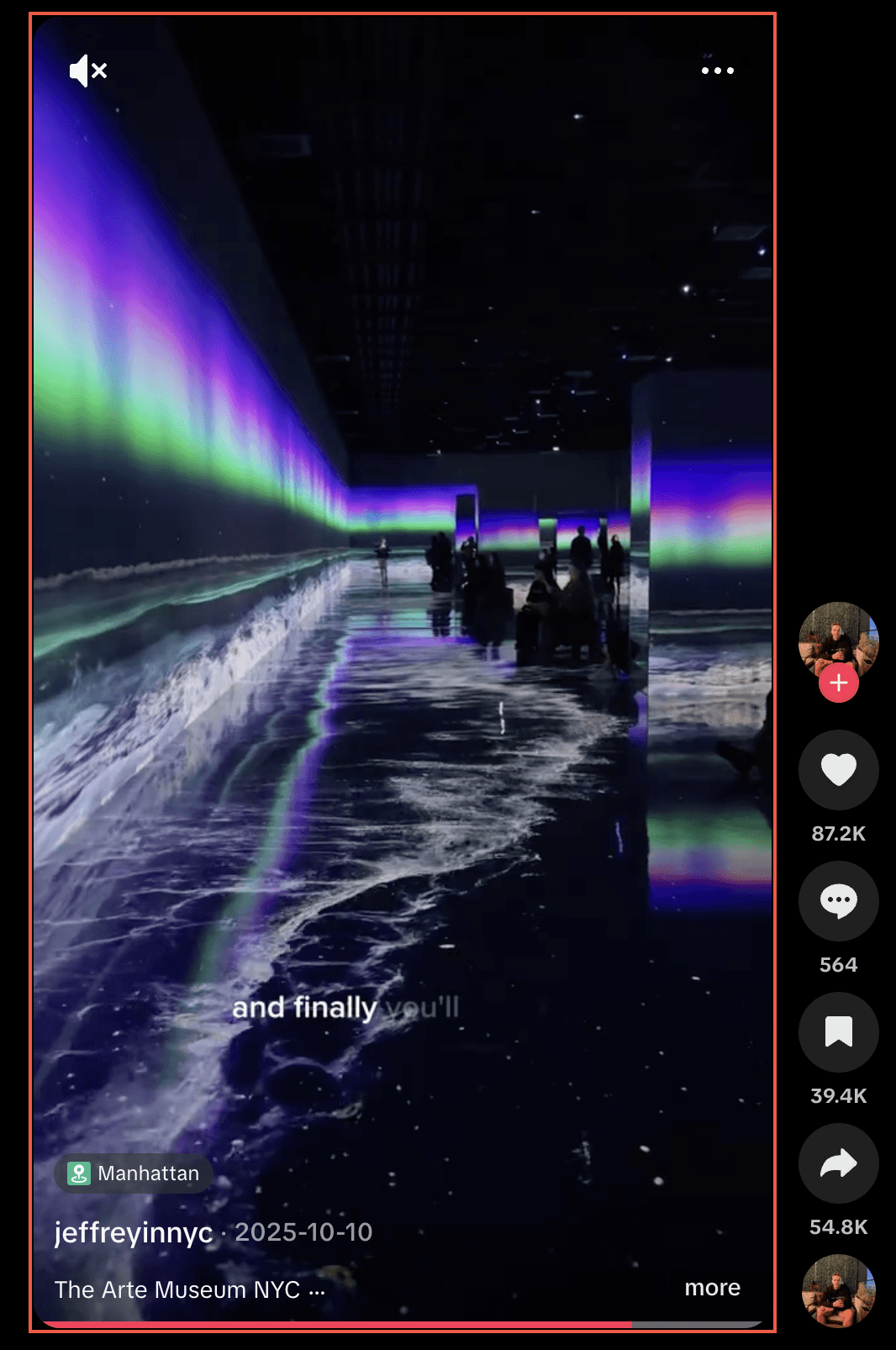
Inspired: scale / light / wall interaction / holographic sea creatures
Inspired: scale / light / wall interaction / holographic sea creatures
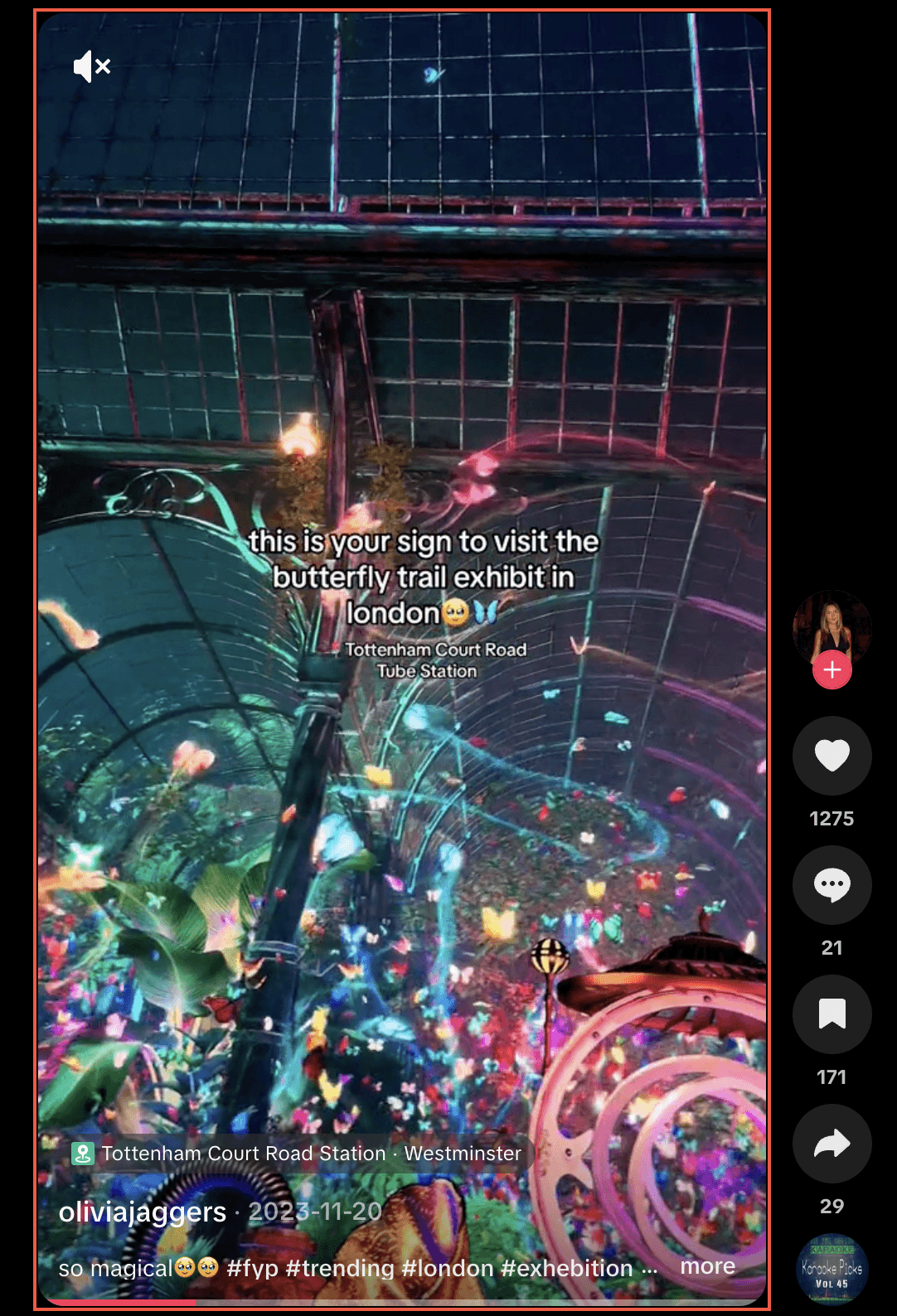
Inspired: butterfly migration / color / movement
Inspired: butterfly migration / color / movement
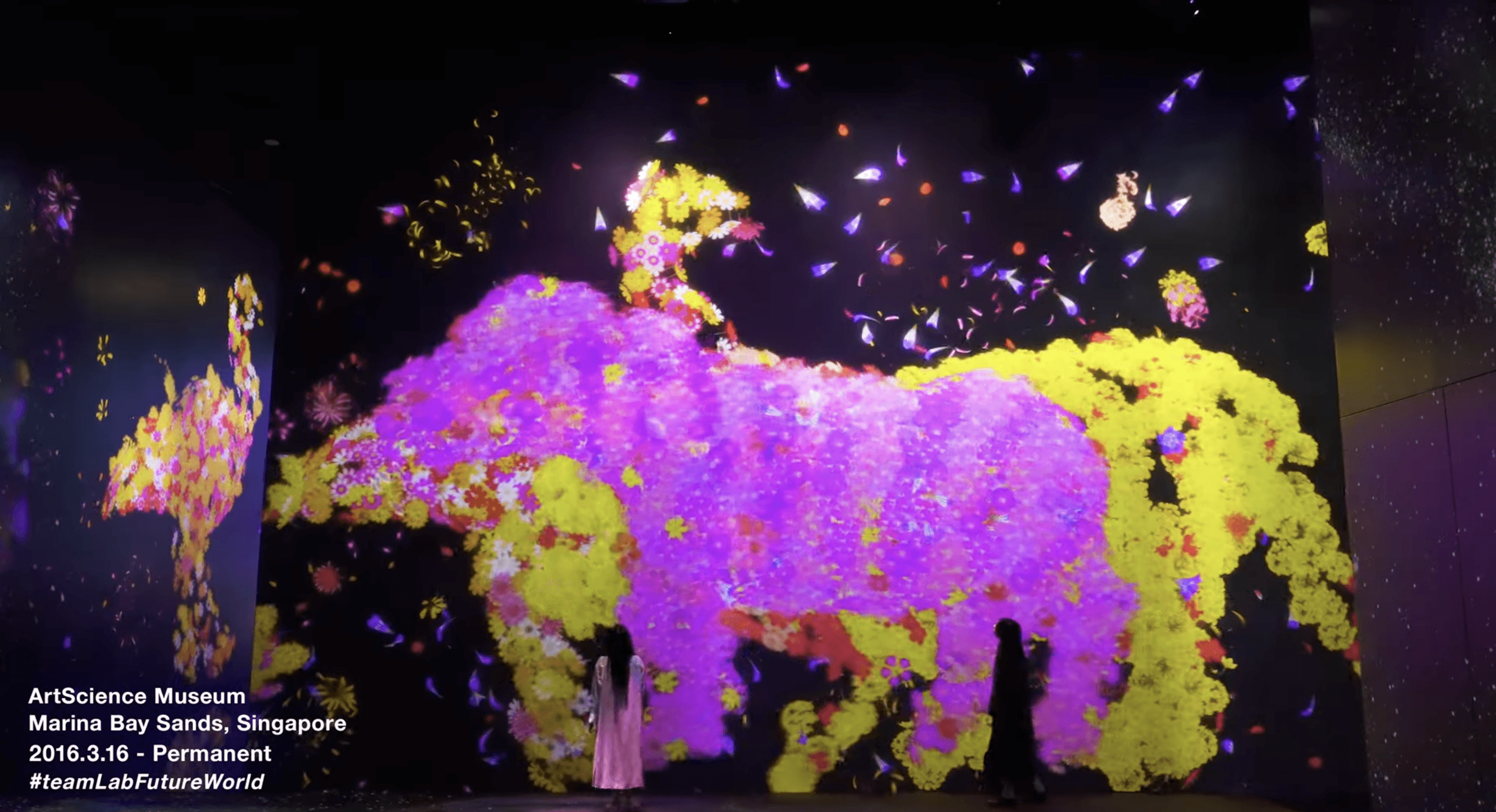
Inspired: color / movement / personal companion building connection / dark-themed room / sound
Inspired: color / movement / personal companion building connection / dark-themed room / sound
Painpoints
Painpoints
Visitors struggled to take away the full story that the museum had to offer guests
Visitors struggled to take away the full story that the museum had to offer guests
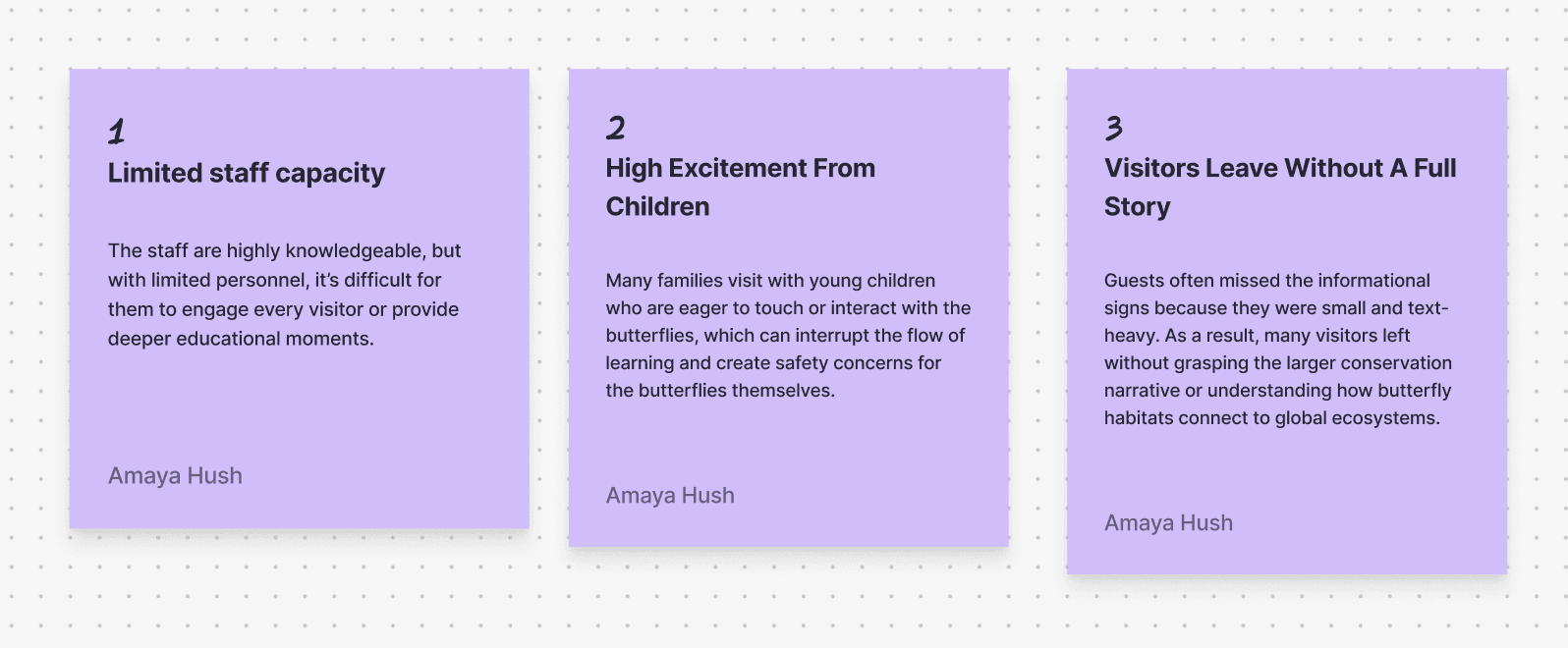
We conducted a short interview with museum staff and visited the conservatory twice to observe how visitors interacted with the space. These conversations and observations helped us understand the core challenges that limit engagement with conservation stories today.
We conducted a short interview with museum staff and visited the conservatory twice to observe how visitors interacted with the space. These conversations and observations helped us understand the core challenges that limit engagement with conservation stories today.
How might we...
How might we...
Our challenge centered on how to encourage deeper engagement with butterfly conservation stories while preserving the magic of the live sanctuary. We needed to understand how technology could enhance learning and immersion without overshadowing the real butterflies or disrupting the sense of awe that comes from encountering them up close.
Our challenge centered on how to encourage deeper engagement with butterfly conservation stories while preserving the magic of the live sanctuary. We needed to understand how technology could enhance learning and immersion without overshadowing the real butterflies or disrupting the sense of awe that comes from encountering them up close.
How might we increase meaningful engagement with butterfly conservation by helping visitors connect personal choices to real ecological impact?
How might we integrate technology thoughtfully so that it supports immersion and storytelling without diminishing the authentic awe from the living environment?
How might we increase meaningful engagement with butterfly conservation by helping visitors connect personal choices to real ecological impact?
How might we integrate technology thoughtfully so that it supports immersion and storytelling without diminishing the authentic awe from the living environment?
How might we increase meaningful engagement with butterfly conservation by helping visitors connect personal choices to real ecological impact?
How might we integrate technology thoughtfully so that it supports immersion and storytelling without diminishing the authentic awe from the living environment?
Low-fidelity storyboarding
Low-fidelity storyboarding
At the start of the project, my partner and I let our ideas run big. We each created an early storyboard to explore different ways technology could bring butterfly conservation to life. One concept focused on drawing a butterfly digitally and using a holographic display to show its evolving state. Visitors would move through the live conservatory and stop at mini stations where environmental choices shaped their companion.
At the start of the project, my partner and I let our ideas run big. We each created an early storyboard to explore different ways technology could bring butterfly conservation to life. One concept focused on drawing a butterfly digitally and using a holographic display to show its evolving state. Visitors would move through the live conservatory and stop at mini stations where environmental choices shaped their companion.
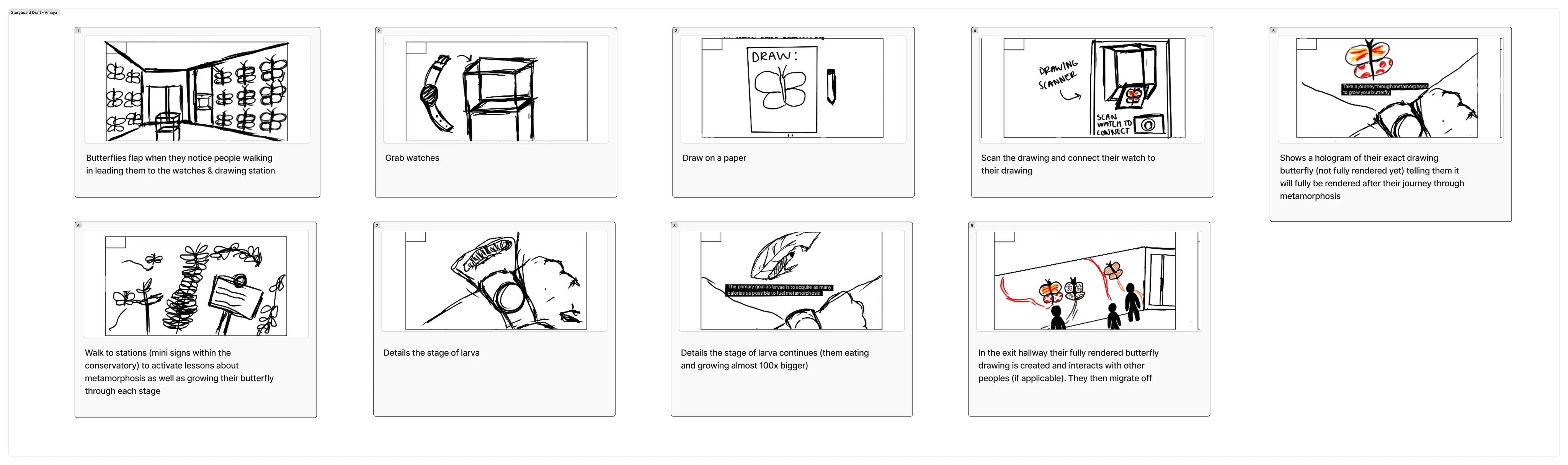
While imaginative, this idea relied on lighting conditions that were difficult to control inside the real butterfly conservatory. The hologram risked competing with the live butterflies, an experience already rich with natural awe. We realized any technology we introduced needed to enhance that emotional impact, not pull attention away from it.
While imaginative, this idea relied on lighting conditions that were difficult to control inside the real butterfly conservatory. The hologram risked competing with the live butterflies, an experience already rich with natural awe. We realized any technology we introduced needed to enhance that emotional impact, not pull attention away from it.
Iteration & refinement
Iteration & refinement
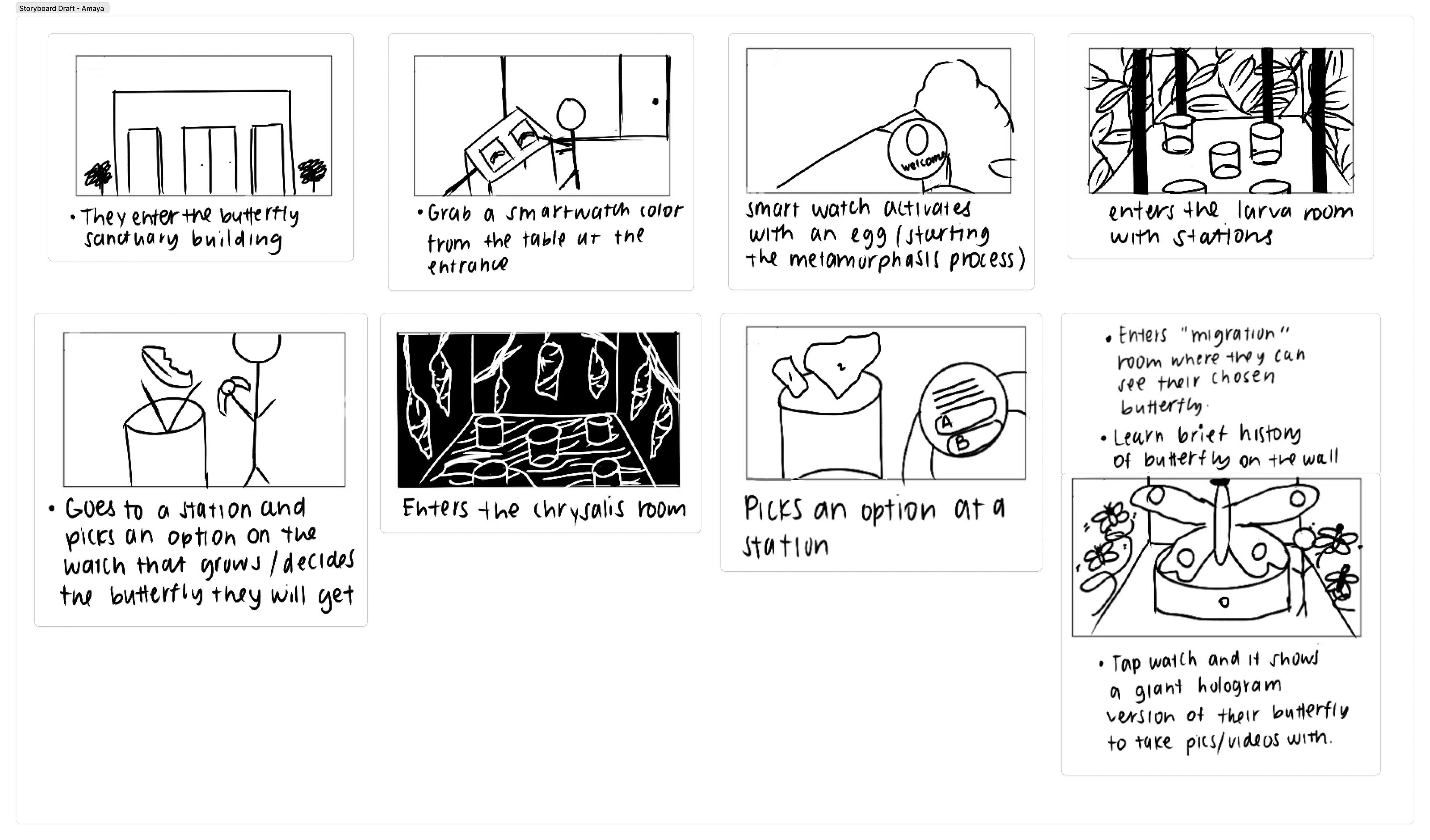
After recieving feedback , we made iterations to focus on creating rooms for the experience. The next idea moved closer to our final direction: breaking the metamorphosis process into three dedicated rooms—Larva, Chrysalis, and Emergence—each driven by a smart bracelet that enabled context-aware interactions. Visitors could move their bracelet toward walls and embedded surfaces to influence their butterfly’s growth.
After recieving feedback , we made iterations to focus on creating rooms for the experience. The next idea moved closer to our final direction: breaking the metamorphosis process into three dedicated rooms—Larva, Chrysalis, and Emergence—each driven by a smart bracelet that enabled context-aware interactions. Visitors could move their bracelet toward walls and embedded surfaces to influence their butterfly’s growth.
Future user journey map
Future user journey map
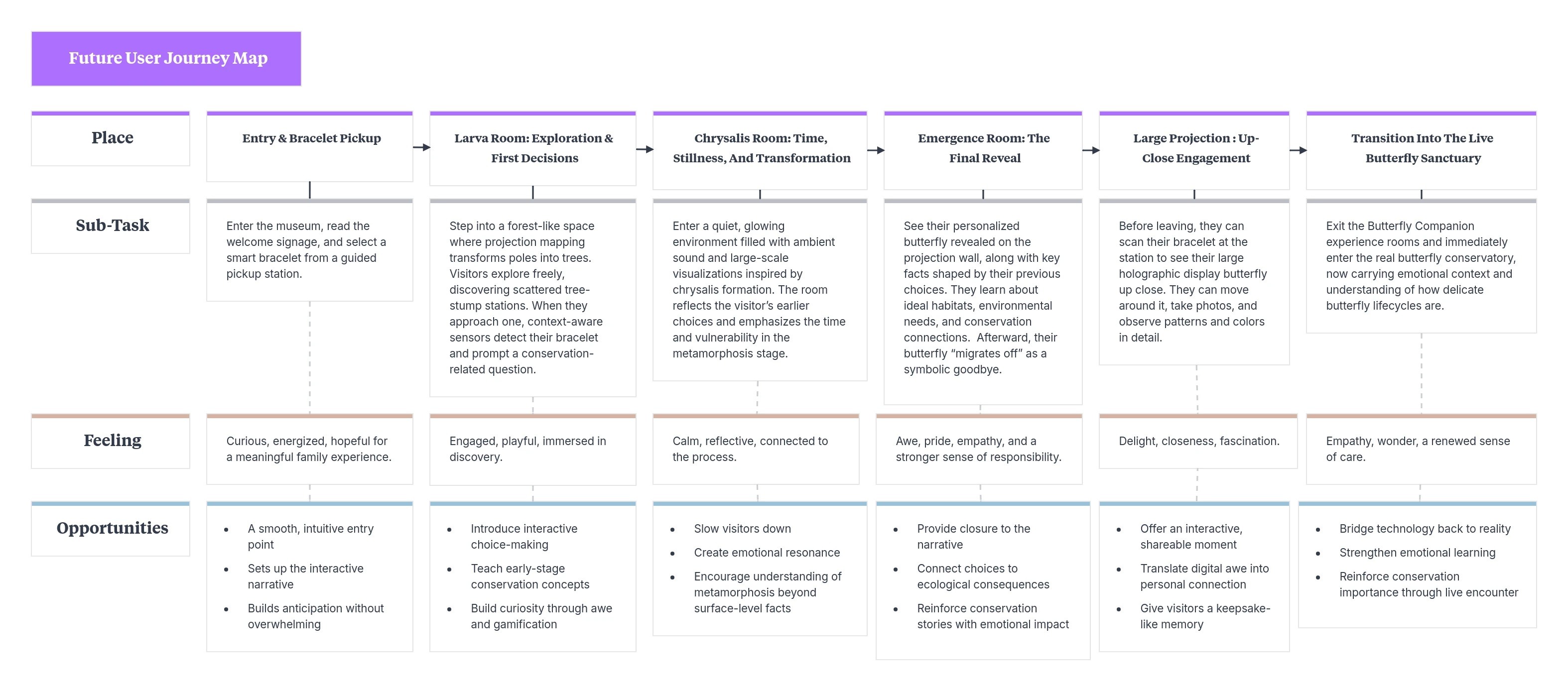
To help redefine our users' experience, we detailed the ideal user journey experience.
To help redefine our users' experience, we detailed the ideal user journey experience.
Design inspiration
Design inspiration
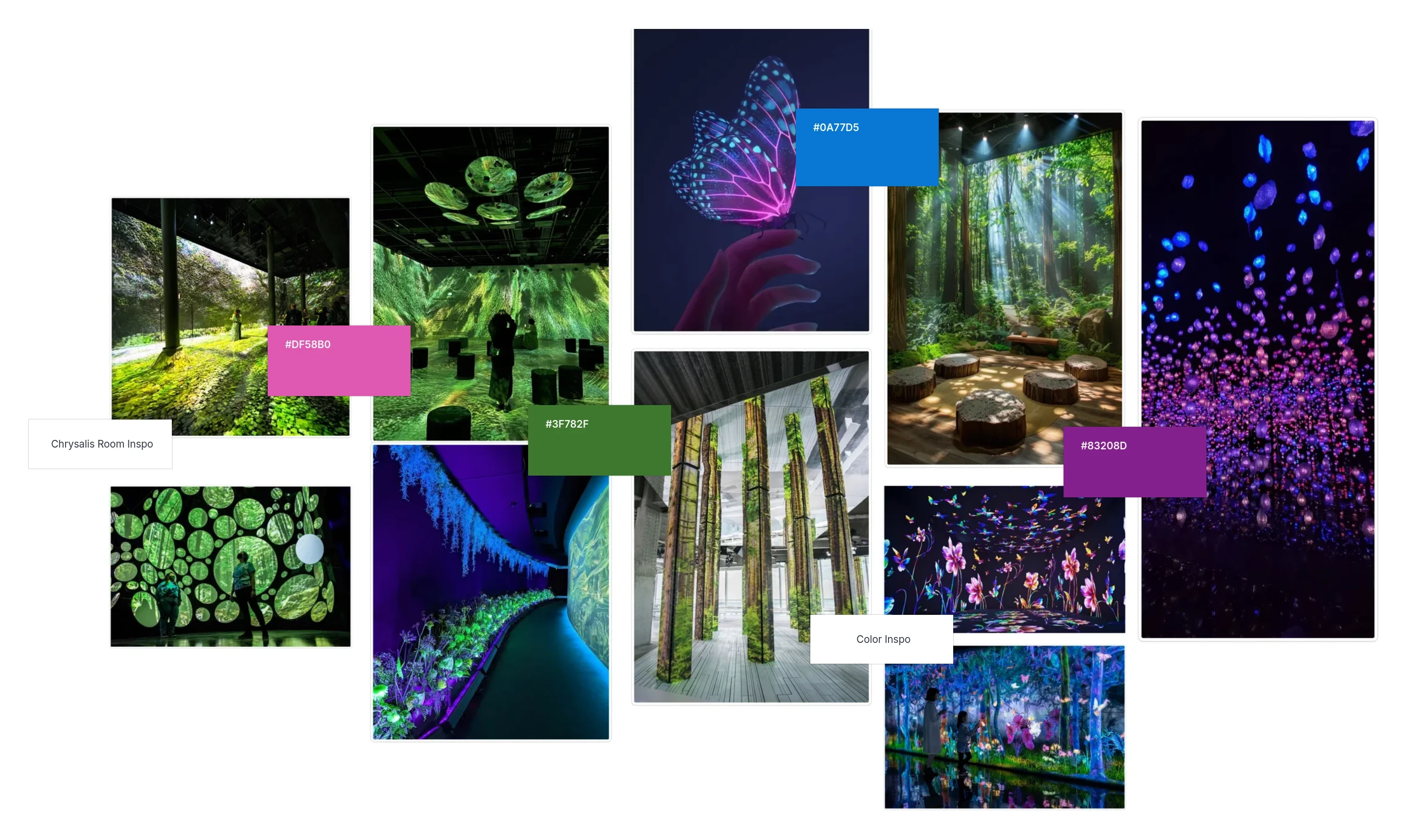
To translate our concept into an immersive visual experience, we relied on a combination of tools, techniques, and layered workflows. We built the core environments for each room in the 3D modeling tool Spline, allowing us to design spaces that felt believable, atmospheric, and emotionally aligned with the metamorphosis journey.
We then collected and created animations using CapCut and Adobe After Effects, blending them with AI-generated imagery produced through a series of iterative prompts. This mix of handcrafted motion, generative visuals, and environmental design allowed us to push the sense of scale and wonder we wanted each room to evoke.
To demonstrate interactions, we filmed green-screen sequences and composited them directly into our 3D environments. This helped visualize how the smart bracelet, wall prompts, and context-aware elements would respond in real time, making the experience feel grounded and cohesive.
To translate our concept into an immersive visual experience, we relied on a combination of tools, techniques, and layered workflows. We built the core environments for each room in the 3D modeling tool Spline, allowing us to design spaces that felt believable, atmospheric, and emotionally aligned with the metamorphosis journey.
We then collected and created animations using CapCut and Adobe After Effects, blending them with AI-generated imagery produced through a series of iterative prompts. This mix of handcrafted motion, generative visuals, and environmental design allowed us to push the sense of scale and wonder we wanted each room to evoke.
To demonstrate interactions, we filmed green-screen sequences and composited them directly into our 3D environments. This helped visualize how the smart bracelet, wall prompts, and context-aware elements would respond in real time, making the experience feel grounded and cohesive.
Green screen footage
Green screen footage
3D animations
3D animations
solution
solution
An immersive experience that helps visitors connect to the metamorphosis process of butterflies by building conservation stories through light, scale, and interactive moments.
An immersive experience that helps visitors connect to the metamorphosis process of butterflies by building conservation stories through light, scale, and interactive moments.
Please pause to read each slide!
Please pause to read each slide!
Key feature 1
Key feature 1
Walking through the forest
Walking through the forest
Projection mapping transforms the space into a forest filled with subtle interactions. When visitors encounter a tree-stump station, context-aware technology recognizes their bracelet and asks a key environmental question. Each choice teaches a quick scientific insight and begins forming their butterfly’s identity.
Projection mapping transforms the space into a forest filled with subtle interactions. When visitors encounter a tree-stump station, context-aware technology recognizes their bracelet and asks a key environmental question. Each choice teaches a quick scientific insight and begins forming their butterfly’s identity.
key feature 2
key feature 2
The butterfly reveal
The butterfly reveal
After the chrysalis stage, visitors meet their butterfly for the first time in an intimate reveal moment. A dedicated display shares quick educational facts about their butterfly species, traits, and environmental needs—connecting each unique companion to a broader conservation story.
After the chrysalis stage, visitors meet their butterfly for the first time in an intimate reveal moment. A dedicated display shares quick educational facts about their butterfly species, traits, and environmental needs—connecting each unique companion to a broader conservation story.
Key feature 3
Key feature 3
Large-scale projection experience
Large-scale projection experience
A separate projection wall allows visitors to see their butterfly up close at an immersive scale. Here they can observe details, explore quick facts, and take photos with their butterfly, creating a lasting memory and deepening their personal connection to the story.
A separate projection wall allows visitors to see their butterfly up close at an immersive scale. Here they can observe details, explore quick facts, and take photos with their butterfly, creating a lasting memory and deepening their personal connection to the story.
Impact & reflection
Impact & reflection
Presenting our proposal to the Museum of Life + Science staff showed how well the experience aligned with their real needs. Staff shared that our three-room structure offered a clear and engaging way to teach metamorphosis for a diverse ages, helping visitors form stronger emotional and scientific connections to conservation.
They appreciated how seamlessly the concept fit within their existing space and visitor flow, noting that several elements were feasible for future implementation. Most importantly, they felt the experience could spark deeper curiosity, conversation, and understanding among families, which is a core goal of the museum.
Looking ahead, there are several opportunities to expand the experience and deepen visitor engagement. One direction is exploring how visitors could compare or adjust their choices, seeing “what if” scenarios that reveal how different environmental factors might change their butterflies’ needs or appearance.We also see potential in adding collaborative moments that allow multiple visitors to interact together. This could include comparing butterflies, sharing facts, or creating group memories through shared projections or photos.
Personally, I really got to see how the design thinking process could apply to immersive experiences. It allowed for even more opportunity with considering light, sound, and scale.
Presenting our proposal to the Museum of Life + Science staff showed how well the experience aligned with their real needs. Staff shared that our three-room structure offered a clear and engaging way to teach metamorphosis for a diverse ages, helping visitors form stronger emotional and scientific connections to conservation.
They appreciated how seamlessly the concept fit within their existing space and visitor flow, noting that several elements were feasible for future implementation. Most importantly, they felt the experience could spark deeper curiosity, conversation, and understanding among families, which is a core goal of the museum.
Looking ahead, there are several opportunities to expand the experience and deepen visitor engagement. One direction is exploring how visitors could compare or adjust their choices, seeing “what if” scenarios that reveal how different environmental factors might change their butterflies’ needs or appearance.We also see potential in adding collaborative moments that allow multiple visitors to interact together. This could include comparing butterflies, sharing facts, or creating group memories through shared projections or photos.
Personally, I really got to see how the design thinking process could apply to immersive experiences. It allowed for even more opportunity with considering light, sound, and scale.